AlphaEvolve Writing
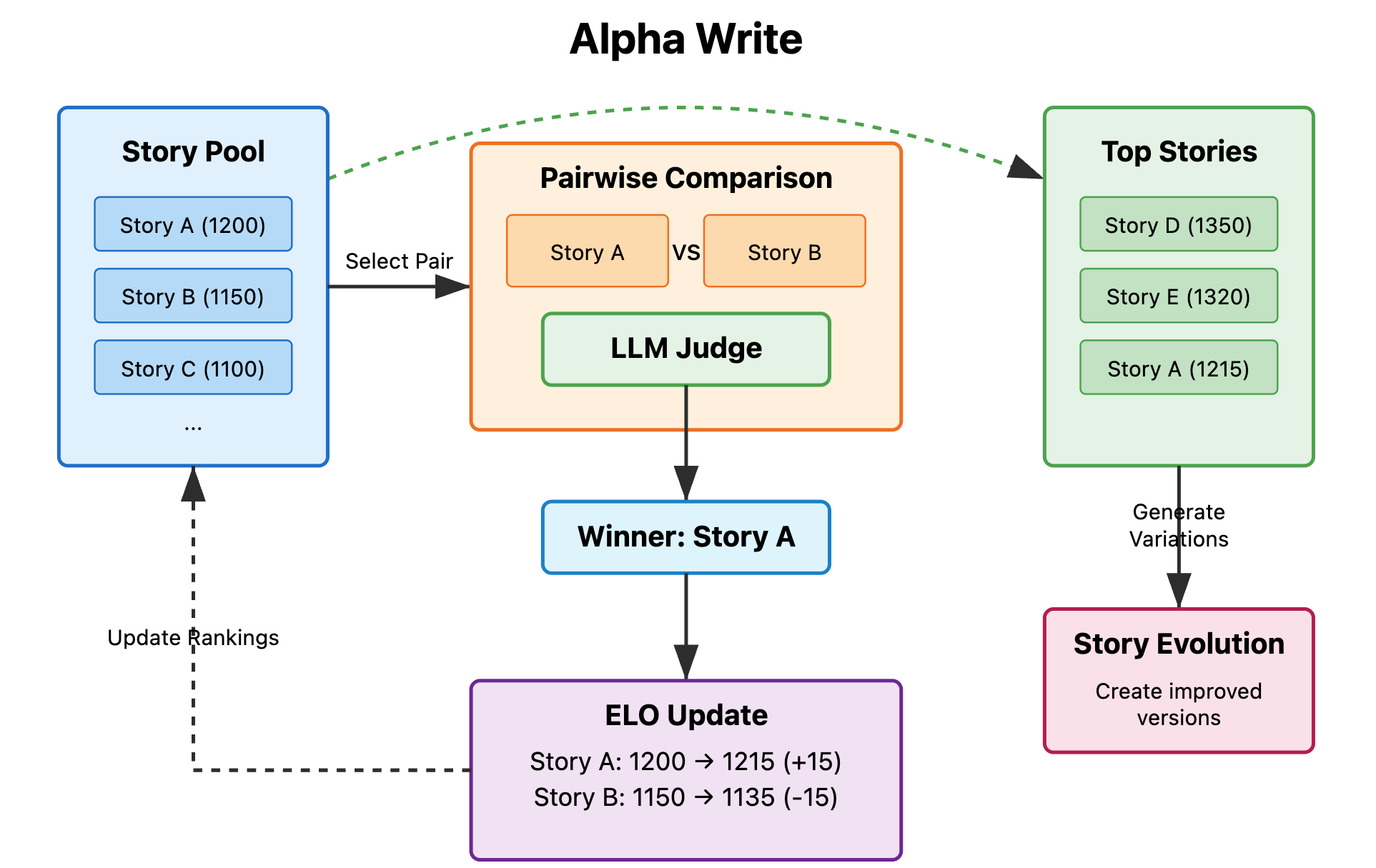
Vous pouvez trouver l'explication complète ici
Vous pouvez trouver un exemple d'histoire soumise à un concours d'écriture ici
Un système moderne et évolutif d’écriture qui utilise des modèles d’IA pour générer, évaluer et faire évoluer des histoires créatives ou des textes généraux à travers des compétitions itératives. Construit avec une architecture Python propre et modulaire suivant les principes de conception modernes.
✨ Fonctionnalités
- 🧬 Algorithme évolutif : Les histoires évoluent grâce à des tournois propulsés par l’IA
- 🎯 Deux modes d’écriture : Rédaction créative et optimisation de texte général
- 🏆 Système de tournoi ELO : Classement sophistiqué via des comparaisons par paires
- 🌐 Interface Web : Validation humaine et outils de comparaison d’histoires
- 🔧 Configurable : Personnalisation étendue via une configuration JSON
🚀 Démarrage rapide
Installation
# Clone the repository
git clone https://github.com/your-org/alphaevolve-writing
cd alphaevolve-writingInstall with uv (recommended)
uv syncOr install with pip
pip install -e .Configure your API keys (see Configuration section below)
Exécuter l'évolution
# Run 5 evolution iterations
python evolve.py 5Fresh start with 3 iterations
python evolve.py 3 --freshUse general writing mode
python evolve.py 5 --generalShow help
python evolve.py --help
🏗️ Architecture
Le système suit les principes de conception modernes de Python avec une séparation claire des responsabilités :
├── src/
│   ├── core/           # Pipeline orchestration
│   │   └── pipeline.py # Main EvolutionPipeline class
│   ├── generators/     # Story generation logic
│   │   ├── story_generator.py      # Initial & next batch generators
│   │   ├── generate_response.py    # Creative writing generation
│   │   ├── generate_response_general.py # General writing generation
│   │   └── judge_response.py       # AI judging system
│   ├── rankers/        # ELO ranking system
│   │   ├── elo_rank.py            # Core ELO algorithm
│   │   └── tournament_runner.py    # Tournament management
│   └── utils/          # Utility functions
│       └── inference.py           # Multi-provider LLM interface
├── evolve.py           # Clean CLI entry point
├── pyproject.toml      # Modern Python packaging
├── config.json         # Configuration
└── web_interface/      # Web UI for validation
Composants clés
EvolutionPipeline: Orchestrateur principal qui gère l'ensemble du cycle d'évolutionInitialStoryGenerator: Crée la première génération d'histoires à partir des promptsNextBatchGenerator: Fait évoluer les meilleurs résultats en variantes amélioréesTournamentRunner: Gère les tournois ELO pour le classement des histoiresEloRankingSystem: Implémente un algorithme de classement sophistiqué
📖 Fonctionnement
Le système suit un cycle d'évolution en trois étapes :
1. Générer le lot initial
- Crée plusieurs histoires à partir de votre prompt
- Utilise des modèles IA configurables (GPT, Claude, Llama, etc.)
- Attribue des notes ELO initiales
2. Lancer le tournoi ELO
- Les histoires s'affrontent en comparaisons par paires
- Des juges IA évaluent selon votre grille
- Les notes ELO sont mises à jour selon les victoires/défaites
3. Générer le lot suivant
- Les meilleures histoires sont sélectionnées
- Des variantes sont générées avec des améliorations
- Le processus se répète sur plusieurs générations
⚙️ Configuration
Configuration de base
Modifiez ces fichiers clés :
prompt.txt- Votre prompt ou thème d'écriturerubric.txt- Critères de jugement pour l'évaluationconfig.json- Configuration du système
Configuration des clés API
Le système prend en charge plusieurs fournisseurs d'IA configurés via config.json. La configuration associe les modèles aux fournisseurs et précise quelles variables d'environnement contiennent les clés API :
{
  "llm_providers": {
    "openai": {
      "type": "openai",
      "base_url": "https://api.openai.com/v1",
      "api_key_env": "OPENAI_API_KEY"
    },
    "anthropic": {
      "type": "anthropic",
      "api_key_env": "ANTHROPIC_API_KEY"
    },
    "deepinfra": {
      "type": "openai_compatible",
      "base_url": "https://api.deepinfra.com/v1/openai",
      "api_key_env": "DEEPINFRA_API_KEY"
    },
    "deepseek": {
      "type": "openai_compatible",
      "base_url": "https://api.deepseek.com/v1",
      "api_key_env": "DEEPSEEK_API_KEY"
    },
    "gemini": {
      "type": "openai_compatible",
      "api_key_env": "GEMINI_API_KEY",
      "base_url": "https://generativelanguage.googleapis.com/v1beta/openai/"
    }
  },
  "model_provider_mapping": {
    "gpt-4": "openai",
    "gpt-3.5-turbo": "openai",
    "claude-3-sonnet-20240229": "anthropic",
    "meta-llama/Meta-Llama-3-70B-Instruct": "deepinfra",
    "deepseek-chat": "deepseek",
    "gemini-2.5-flash": "gemini"
  }
}export OPENAI_API_KEY="your-openai-key" # For GPT models
export ANTHROPIC_API_KEY="your-anthropic-key" # For Claude models
export DEEPINFRA_API_KEY="your-deepinfra-key" # For Llama models
export DEEPSEEK_API_KEY="your-deepseek-key" # For DeepSeek models
export GEMINI_API_KEY="your-gemini-key" # For Gemini modelsOptions de configuration
Le fichier config.json contrôle tout le comportement du système :
{
  "batch_generation": {
    "num_stories": 10,
    "model": "gpt-4",
    "initial_elo": 1500
  },
  "elo_ranking": {
    "tournament_rounds": 50,
    "judge_model": "claude-3-sonnet-20240229",
    "k_factor": 32
  },
  "next_batch_generation": {
    "top_stories_to_select": 3,
    "variants_per_story": 2,
    "include_original_stories": true
  },
  "evolution_pipeline": {
    "max_iterations": 5,
    "auto_continue_from_existing": true
  }
}
🎭 Modes d’écriture
Mode d’écriture créative (Par défaut)
- Se concentre sur la narration, le développement des personnages et les techniques narratives
- Utilise des stratégies de génération basées sur des missions
- Optimise la créativité et l’engagement
Mode d’écriture générale (--general)
- Se concentre sur les articles académiques, les essais, les rapports et l’écriture professionnelle
- Utilise des approches analytiques et structurées
- Optimise la clarté et la force de persuasion
🔧 Configuration avancée
Personnalisation des stratégies de génération
Pour les utilisateurs avancés, vous pouvez personnaliser les invites de génération, les styles d’auteur et les ensembles de missions en modifiant les fichiers du répertoire src/generators/ :
#### Personnalisation de l’écriture créative (src/generators/generate_response.py)
Ensembles de missions - Définir des approches et objectifs créatifs :
mission_sets = {
    "emotional_depth": [
        "Focus on the psychological depth of characters",
        "Explore complex emotional landscapes",
        "Create moments of genuine human connection"
    ],
    "narrative_craft": [
        "Experiment with unique narrative structures",
        "Use vivid, sensory descriptions",
        "Create compelling story arcs"
    ],
    "dialogue_mastery": [
        "Write authentic, character-specific dialogue",
        "Use subtext and implied meaning",
        "Balance dialogue with action and description"
    ]
}author_styles = [
"Write with the psychological insight of Virginia Woolf",
"Adopt the sparse, powerful prose of Ernest Hemingway",
"Use the magical realism style of Gabriel García Márquez",
"Employ the detailed world-building of Tolkien"
]src/generators/generate_response_general.py)Domaines d’accent académique - Cibler des domaines spécifiques d’écriture :
academic_focuses = [
    "Rigorous analytical argument development",
    "Clear thesis statement and supporting evidence",
    "Proper academic citation and source integration",
    "Logical flow and coherent structure"
]writing_approaches = [
"Comparative analysis with multiple perspectives",
"Problem-solution framework with evidence",
"Cause-and-effect reasoning with examples",
"Critical evaluation with balanced arguments"
]Personnalisation des critères de jugement (src/generators/judge_response.py)
Vous pouvez modifier les critères de jugement et les invites d'évaluation pour vous concentrer sur des aspects spécifiques de la qualité de l'écriture :
# Edit the judge_responses function to customize evaluation criteria
evaluation_criteria = [
    "Technical writing proficiency",
    "Creative originality and innovation",
    "Emotional impact and reader engagement",
    "Structural coherence and flow",
    "Character development and authenticity"
]
Conseils pour une configuration avancée
- Sauvegardez les fichiers originaux : Gardez toujours des copies des fichiers générateurs originaux avant d’apporter des modifications
- Testez de manière incrémentale : Apportez de petits changements et testez-les sur quelques itérations avant de lancer des cycles d’évolution complets
- Surveillez les résultats : Utilisez l’interface web pour valider que vos personnalisations améliorent la qualité des histoires
- Mixez et associez : Combinez différents ensembles de missions et styles d’auteur pour des stratégies de génération uniques
- Contrôle de version : Suivez vos personnalisations avec git afin de pouvoir revenir en arrière si nécessaire
🌐 Interface web
Validez vos résultats d’évolution avec l’interface web intégrée :
cd web_interface
pip install -r requirements.txt
python app.py- Comparaison d'histoires : Lecture côte à côte et sélection de préférence
- Classements ELO : Voir les classements actuels et les statistiques
- Suivi de l'évolution : Valider que les générations ultérieures s'améliorent
- Exportation de données : Télécharger les résultats pour analyse
--- Tranlated By Open Ai Tx | Last indexed: 2025-07-18 ---