🌐 Language
MiciMike drop-in PCB replacement for Google Nest Mini
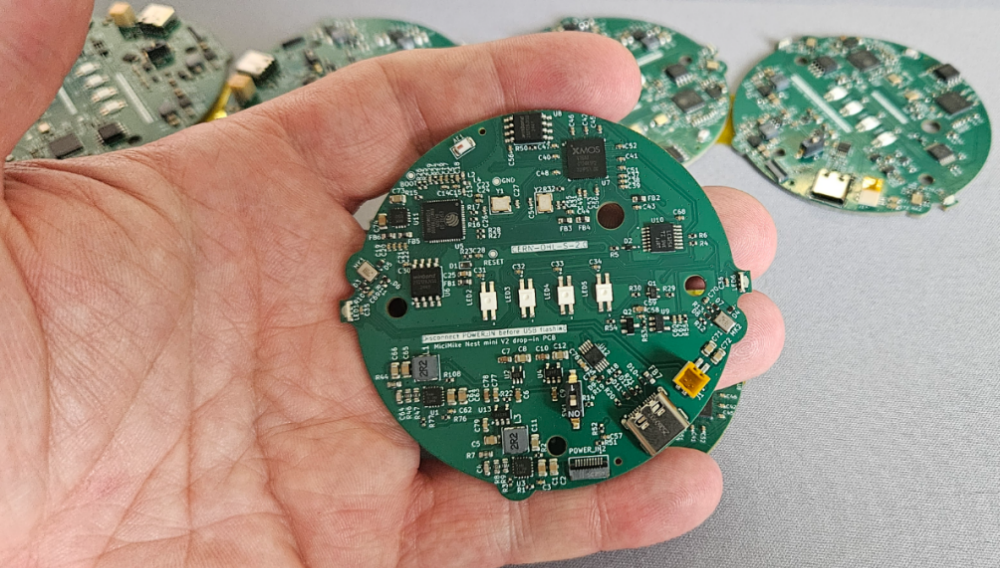
MiciMike Nest Mini is a drop-in PCB replacement for the "Google Nest Mini" (Google's second-generation smart speaker with a barrel connector charging port)), but based on ESP32 and XMOS microcontrollers for running open-source firmware.
Tip! If you are instead looking for a similar drop-in PCB replacement for the "Google Home Mini" (Google's first-generation smart speaker hardware with a Micro-USB charging port) then check out the sister-project at https://github.com/iMike78/home-mini-v1-drop-in-pcb
Heads-up! There is currently an ongoing crowdfunding campaign for the "MiciMike Home Mini Drop-In PCB" (1st-gen Google Home Mini) that is now live on Crowd Supply in a pre-sale phase (project preview only), and if that is successful, then a matching campaign for the newer Nest Mini (2nd-gen) is planned. So check it out here and support this project indirectly by backing it if you can:
- https://www.crowdsupply.com/micimike-rev-devices/micimike-home-mini-drop-in-pcb
Project scope
The goal of this project and repository (similar to Onju Voice but under a fully open-source hardware license) is to design a drop-in replacement PCB (Printed Circuit Board) with hardware schematics that anyone can make/build or order from a one-stop PCB manufacturer as a custom drop-in replacement PCB for the Google Nest Mini (2nd Gen).
This is primarily targeting people looking to convert/repurpose their old Google Nest Mini smart speakers into open-source hardware for Voice Control of Home Assistant and/or media player speaker output for Music Assistant, (the hardware can likely also be used with other applications and firmware as it is based on the popular Espressif ESP32 platform).
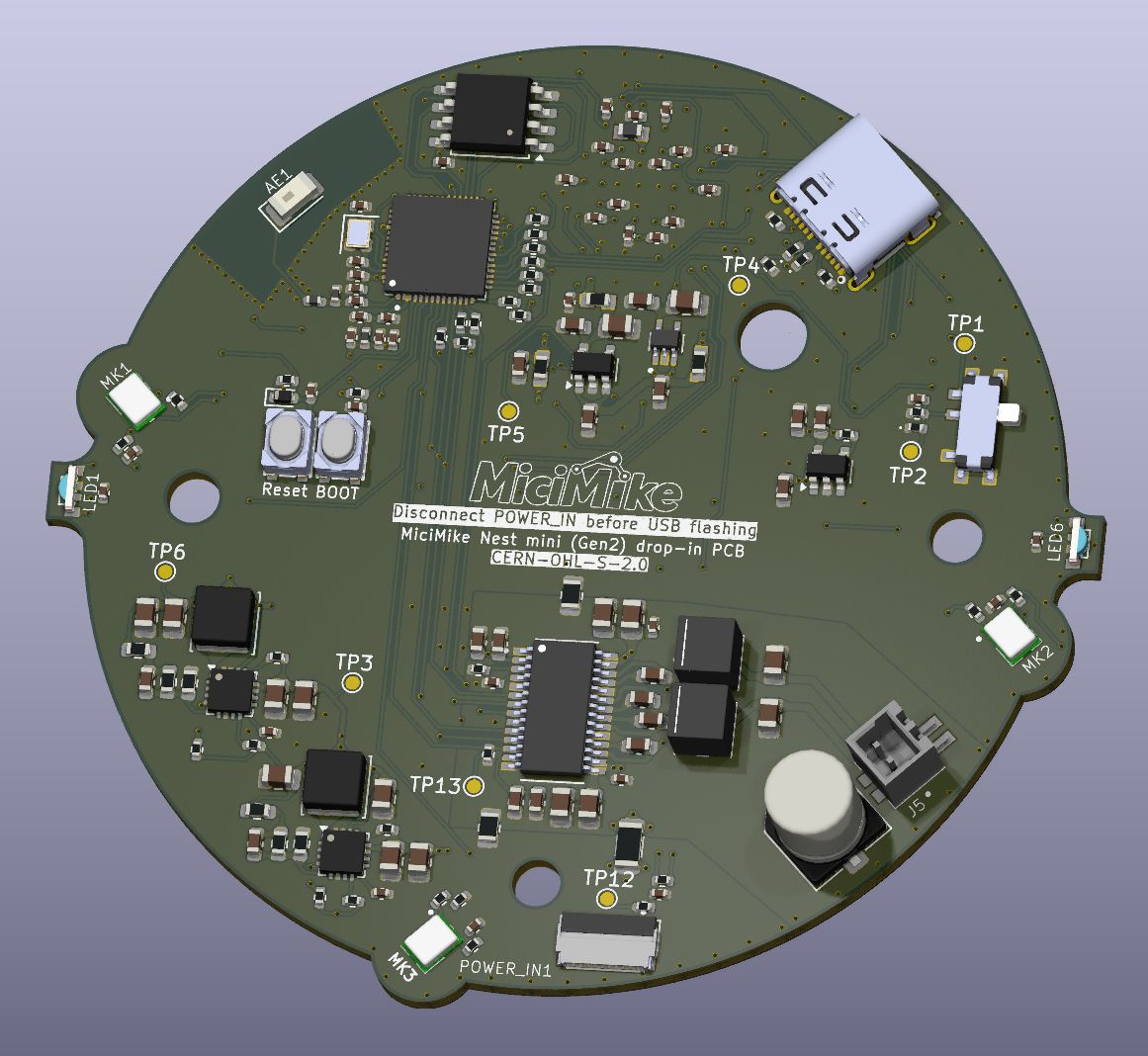
The hardware design will (like Home Assistant Voice Preview Edition) integrate an ESP32-S3 SoC for WiFi, BLE, and onboard wake-word detection (using no-code ESPHome firmware) + an XMOS xCORE XU316 chip for advanced audio processing (with custom firmware for microphone cleanup offloading to improve voice recognition by using locally running algorithms for Noise Suppression, Acoustic Echo Cancellation, Interference Cancellation, and Automatic Gain Control).
Functionality-wise, it is made to be mostly hardware compatible with the Home Assistant Voice Preview Edition (a.k.a. Home Assistant Voice PE reference design (which has been released as open-source hardware from the Open Home Foundation in collaboration with Nabu Casa). The main difference will be due to constraints defined by the Google Nest Mini enclosure and components, (i.e., the nest-mini-drop-in-pcb project hardware design will be limited by the same physical capacity inputs as the original hardware from Google).
Therefore, the scope of this project/repository is not to develop new features/functions for the ESPHome firmware. If you want that, you need to turn to the firmware development of the Home Assistant Voice Preview Edition as well as the upstream ESPHome mainline code:
- https://github.com/esphome/home-assistant-voice-pe
- https://github.com/esphome/esphome
- https://github.com/esphome/feature-requests
Request for collaboration
If you have experience with PCB layout design (especially PCB routing, ground pouring, or noise-sensitive digital+analog layouts), your help is highly appreciated! Please feel free to open a new issue, submit suggestions/requests, and add input/feedback to existing issues, or fork this repository.
For more information about the concept/idea, see and contribute to related discussions in this Home Assistant community forum thread:
- https://community.home-assistant.io/t/any-news-on-alternative-to-onju-voice-pcb-repacement-design-for-google-nest-home-mini-speakers-with-added-xmos-chip-to-match-official-home-assistant-voice-preview-edition-reference-hardware/860001/
Current status
- ✅ Schematic completed
- ✅ Component placement done
- ✅ Routing is done
- ✅ Ground pour, shielding strategy, and EMI considerations done
- ⛔ 1st test batch failed on two errors - fixed
- ⚠️ 2nd test batch partially working
- ✅ XTAG4 debug option added for the next batch
Tools used
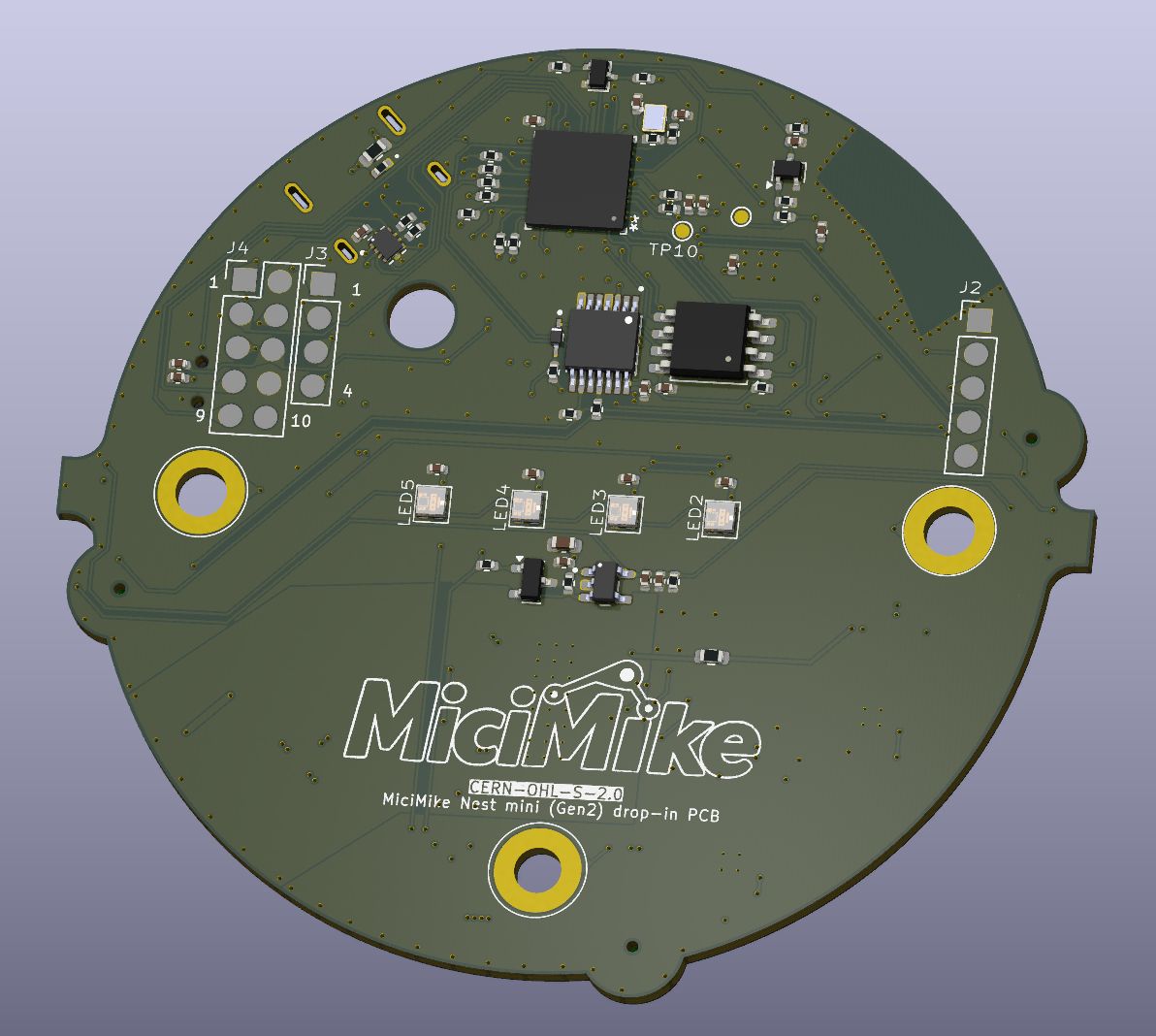
- 🛠️ KiCad 9
- 🧰 SnapEDA / LCSC for footprint sourcing
Known hardware specifications
- 4-layer PCB
- ESP32-S3R8 bare chip (ESP32-S3 for WiFi, BLE, and onboard wake-word detection)
- XMOS XU316-1024-QF60B-C24 (XMOS XU316 xCORE DSP audio processing)
- 16 MB SPI flash (ESP32-S3)
- 4 MB SPI flash (XMOS XU316)
- Dual I²S buses (simultaneous audio input and output)
- TAS5805M (TAS5805MPWPR) stereo Class-D amplifier with integrated DSP (I2S audio, I2C control), configured for mono BTL speaker output
- 3x MEMS microphones (MMICT390200012) arranged on a 34 mm radius arc - current firmware uses 2 microphones, hardware support for a 3-microphone array is already present
- 6x SK6812 RGB LEDs
- Custom USB-C and 14V power input (Note! USB-C and barrel-connector can not be connected at the same time)
- MPR121 capacitive touch controller (used for touch input instead of ESP32-S3 native touch sensing)
⚠️ Flashing via USB-C requires disconnecting the main 14V power input. See silkscreen note on PCB for details.
References
Home Assistant Voice Preview Edition resources including PCB design files
- https://www.home-assistant.io/blog/2024/12/19/voice-preview-edition-the-era-of-open-voice/
- https://voice-pe.home-assistant.io/resources/
- https://support.nabucasa.com/hc/en-us/articles/26195279589277-Home-Assistant-Voice-Preview-Edition-PCB-design-files
- https://raw.githubusercontent.com/NabuCasa/support/refs/heads/main/static/docs/voice/home_assistant_voice_pe_schematic_v1.0_241009.pdf
- https://github.com/esphome/home-assistant-voice-pe
- https://esphome.github.io/home-assistant-voice-pe/
- https://voice-pe.home-assistant.io/
XMOS xCORE DSP (XU316-1024-QF60B-C24) MCU IC chip
- https://www.xmos.com/download/XU316-1024-QF60B-xcore.ai-Datasheet(3).pdf
- https://www.xmos.com/software-tools/
- https://www.xmos.com/develop/xcore-voice
- https://www.xmos.com/usb-multichannel-audio/
- https://www.xmos.com/xcore-ai
- https://github.com/esphome/voice-kit-xmos-firmware
- https://github.com/esphome/xmos_fwk_rtos
- https://github.com/esphome/xmos_fwk_io
License
This project is licensed under the [CERN Open Hardware License Version 2 - Strongly Reciprocal (CERN-OHL-S v2)] Any modified version of this hardware must also be distributed under the same license.
☕ If you’d like to support this project, feel free to buy me a coffee on Ko-fi!
--- Tranlated By Open Ai Tx | Last indexed: 2026-06-24 ---