🌐 ภาษา
น้อยก็เพียงพอ: สังเคราะห์ข้อมูลที่หลากหลายในพื้นที่คุณลักษณะของ LLMs
นี่คือการนำเสนอการใช้งานจริงของบทความ: น้อยก็เพียงพอ: สังเคราะห์ข้อมูลที่หลากหลายในพื้นที่คุณลักษณะของ LLMs
ข้อมูลเชิงลึกหลัก
✨ ทำงานอย่างชาญฉลาด ไม่ใช่แค่หนักขึ้น
ในขั้นตอนหลังการฝึกของ LLMs แทนที่จะเพิ่มข้อความที่หลากหลายเพียงผิวเผินจำนวนมากโดยไร้ทิศทาง การระบุและสังเคราะห์คุณลักษณะสำคัญที่ขาดจริง ๆ อย่างแม่นยำจะมีประสิทธิภาพมากกว่า ด้วยตัวอย่างสังเคราะห์ที่ตรงเป้าหมายเพียงเล็กน้อย เราสามารถเติมช่องว่างใน Feature Activation Coverage (FAC) ได้อย่างมีนัยสำคัญ นำไปสู่การพัฒนาประสิทธิภาพที่ชัดเจนในงานต่อยอด
เหตุใดข้อค้นพบนี้จึงเรียบง่ายแต่ทรงพลัง?
การสังเคราะห์ข้อมูลแบบดั้งเดิมเน้นปริมาณและความหลากหลายทางผิวเผิน (คำศัพท์ รูปแบบประโยค การกระจายหัวข้อ) แต่สิ่งเหล่านี้มักเป็นแค่ ตัวแทนอ่อนแอ สิ่งที่กำหนดผลการทำงานของโมเดลในงานต่อยอดจริง ๆ คือ การครอบคลุมคุณลักษณะสำคัญที่งานเป้าหมายต้องการ
งานของเราแสดงให้เห็นว่า:
- ข้อความจำนวนมากที่ "ดูแตกต่างกันมาก" แท้จริงแล้วกระตุ้นคุณลักษณะที่ซ้อนทับกันสูง;
- FAC ทำนายผลการทำงานในงานต่อยอดได้ดีกว่าตัวชี้วัดความหลากหลายมาตรฐาน รวมถึง Distinct-1/2 และ n-gram Entropy ในระดับคำ POS-tag Distinct-2 ในระดับไวยากรณ์ และ Pair CosDist กับ Semantic Entropy ในระดับ embedding
- สำหรับการตามคำสั่ง FAC Synthesis ให้ผลลัพธ์เทียบเท่า SOTA เดิมอย่าง MAGPIE โดยใช้ข้อมูลน้อยกว่า MAGPIE ถึง 150×
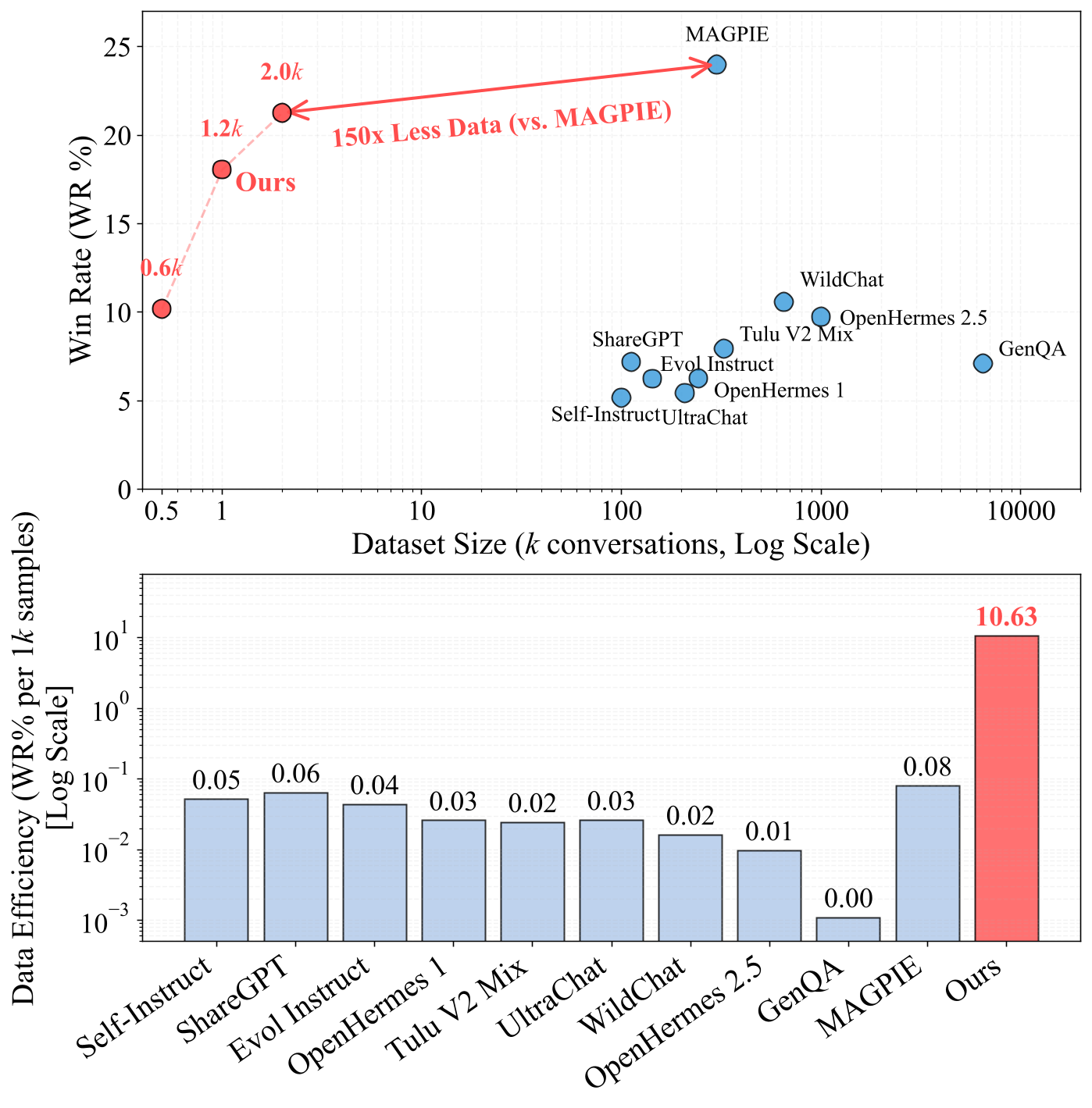
รูปที่ 1: เส้นประสิทธิภาพของชุดข้อมูลการตามคำสั่ง วิธีที่เสนอของเราได้ Win Rate ใน AlpacaEval 2.0 เทียบเท่า MAGPIE โดยใช้ตัวอย่างสังเคราะห์เพียง 2K (เทียบกับ 300K ของ MAGPIE)
เริ่มต้นใช้งาน
การติดตั้ง
git clone https://github.com/Zhongzhi660/FAC-Synthesis.git
cd FAC-Synthesis
pip install -r requirements.txt
Repository Structure
FAC-Synthesis/
├── LICENSE
├── README.md
├── requirements.txt
│
├── sae_pretrain/                 # SAE pretraining
│   ├── datasets/                 # pretraining corpora (constructed from public sources)
│   └── outputs/                  # SAE pre-trained weights
│
├── sae_feature_analysis/         # SAE feature analysis pipeline
│   ├── interpret_features/       # feature interpretation (span collection + annotation)
│   ├── identify_task_relevant_features/   # task-relevant feature identification
│   └── identify_missing_features/         # missing-feature discovery (coverage gap)
│
├── fac_synthesis/                # FAC synthesis pipeline
│   ├── step1_contrastive_pair_construction/      # Step-1: contrastive pair construction
│   └── step2_feature_covered_sample_synthesis/   # Step-2: feature-covered synthesis
│
└── training_scripts/             # Downstream training / evaluation scripts
    ├── toxicity_detection/
    ├── reward_modeling/
    ├── instruction_following/
    └── behavior_steering/
การฝึกล่วงหน้า Sparse Autoencoders
สคริปต์ส่วนใหญ่สำหรับการฝึกล่วงหน้า SAE จะอยู่ในsae_pretrain/ เราได้จัดเตรียมจุดตรวจ SAE ที่ฝึกล่วงหน้าไว้แล้วบน Hugging Face:
- Llama-3.1-8B-Instruct SAE: Zhongzhi1228/sae_llama_l16_h65536
- Qwen2-7B-Instruct SAE: Zhongzhi1228/sae_qwen_l14_h65536
- Mistral-7B-Instruct SAE: Zhongzhi1228/sae_mistral_l16_h65536
# Step-1: Collect hidden activations from the backbone LLM (e.g., layer 16)
python create_actvs_uni.py 0 0 1 meta-llama/Llama-3.1-8B-Instruct 16Step-2: Train SAEs on the target layer (e.g., layer 16)
python train_SAEs.py 0 16 meta-llama/Llama-3.1-8B-Instruct /sae_input/prompt_actvs_l16
การวิเคราะห์คุณลักษณะของ SAE
สคริปต์การวิเคราะห์คุณลักษณะจะอยู่ในsae_feature_analysis/ หากต้องการจัดกลุ่มช่วงการกระตุ้นและสร้างการตีความคุณลักษณะที่อ่านง่ายสำหรับมนุษย์ ให้รัน:# Step-1: Group extracted activation spans
python groupby_textspans.py /xxx/threshold_0.0Step-2: Annotate feature explanations based on grouped spans
python annotate_explanations.py /xxx/threshold_0.0.tsvStep-3: Identify task-relevant features from the explanations
python annotate_toxicity.py /xxx/threshold_0.0_explained.tsvStep-4: Identify missing features via FAC analysis
python identify_fac.py anchor_features.tsv (complete) task_features.tsv (currently available)การสังเคราะห์ข้อมูลโดยการนำทางด้วยการครอบคลุม
สคริปต์การสังเคราะห์ที่นำทางด้วยการครอบคลุมจะอยู่ใน fac_synthesis/. ในการสร้างคำถามสังเคราะห์ ให้รัน# Step-1 (1): Contrastive Pair Construction
python generate_data_llama_r1.py \
--features xxx.tsv \
--out xxx \
--temperature 0.8
Step-1 (2): Feature-Covered Sample Synthesis
python analyze_step1_synthetic_data.py
python merge_step1_failed_cases.pyStep-2: Feature-Covered Sample Synthesis
python generate_data_llama_r2.py \
--features xxx.tsv \
--out xxx \
--temperature 0.8คำขอบคุณ
ในขั้นตอนการประเมินผล สคริปต์การฝึกและทดสอบแบบ downstream ของเราได้รับการปรับแต่งจากคลังโอเพ่นซอร์สดังต่อไปนี้:
การอ้างอิง
หากคุณพบว่างานนี้เป็นประโยชน์ต่อการวิจัยของคุณ กรุณาอ้างอิงงานวิจัยของเรา 🤩:
@article{li2026less,
  title={Less is Enough: Synthesizing Diverse Data in Feature Space of LLMs},
  author={Li, Zhongzhi and Wu, Xuansheng and Li, Yijiang and Hu, Lijie and Liu, Ninghao},
  journal={arXiv preprint arXiv:2602.10388},
  year={2026}
}
--- Tranlated By Open Ai Tx | Last indexed: 2026-05-27 ---