🌐 Language
Less is Enough: Synthesizing Diverse Data in Feature Space of LLMs
This is the official implementation of the paper: Less is Enough: Synthesizing Diverse Data in Feature Space of LLMs.
Core Insight
✨ Work smarter, not harder.
In the post-training phase of LLMs, instead of blindly adding massive amounts of superficially diverse text, it is more effective to precisely identify and synthesize those truly missing key features. With only a small number of targeted synthetic samples, we can significantly fill the gaps in Feature Activation Coverage (FAC), leading to clear performance improvements on downstream tasks.
Why is this insight simple yet powerful?
Traditional data synthesis focuses on quantity and surface diversity (vocabulary, sentence patterns, topic distribution), but these are often just weak proxies. What truly determines a model's downstream performance is the coverage of key features required by the target task.
Our work reveals:
- Many texts that "appear very different" actually activate highly overlapping features;
- FAC predicts downstream performance much better than standard diversity metrics, including Distinct-1/2 and n-gram Entropy at the word level, POS-tag Distinct-2 at the syntax level, and Pair CosDist and Semantic Entropy at the embedding level.
- For instruction following, FAC Synthesis achieves performance comparable to the prior SOTA MAGPIE, while requiring 150× less data than MAGPIE.
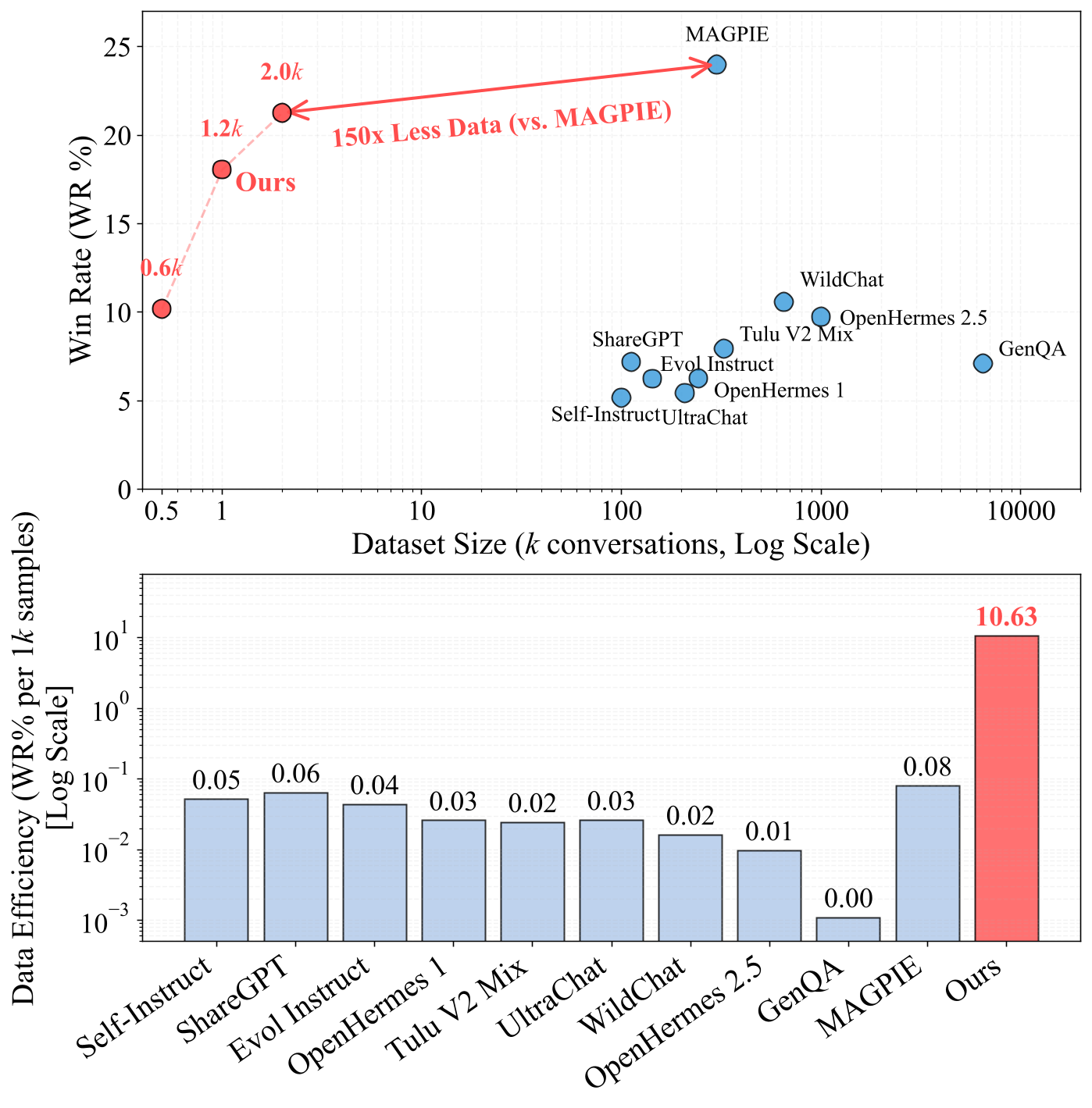
Figure 1: The Efficiency Frontier of Instruction Following Datasets. Our proposed method achieves a Win Rate on AlpacaEval 2.0 comparable to MAGPIE while using only 2K synthetic samples (vs. 300K for MAGPIE).
Getting Started
Installation
git clone https://github.com/Zhongzhi660/FAC-Synthesis.git
cd FAC-Synthesis
pip install -r requirements.txt
Repository Structure
FAC-Synthesis/
├── LICENSE
├── README.md
├── requirements.txt
│
├── sae_pretrain/                 # SAE pretraining
│   ├── datasets/                 # pretraining corpora (constructed from public sources)
│   └── outputs/                  # SAE pre-trained weights
│
├── sae_feature_analysis/         # SAE feature analysis pipeline
│   ├── interpret_features/       # feature interpretation (span collection + annotation)
│   ├── identify_task_relevant_features/   # task-relevant feature identification
│   └── identify_missing_features/         # missing-feature discovery (coverage gap)
│
├── fac_synthesis/                # FAC synthesis pipeline
│   ├── step1_contrastive_pair_construction/      # Step-1: contrastive pair construction
│   └── step2_feature_covered_sample_synthesis/   # Step-2: feature-covered synthesis
│
└── training_scripts/             # Downstream training / evaluation scripts
    ├── toxicity_detection/
    ├── reward_modeling/
    ├── instruction_following/
    └── behavior_steering/
Pre-training Sparse Autoencoders
Most of the scripts for SAE pretraining are located insae_pretrain/. We provide pre-trained SAE checkpoints on Hugging Face:
- Llama-3.1-8B-Instruct SAE: Zhongzhi1228/sae_llama_l16_h65536
- Qwen2-7B-Instruct SAE: Zhongzhi1228/sae_qwen_l14_h65536
- Mistral-7B-Instruct SAE: Zhongzhi1228/sae_mistral_l16_h65536
# Step-1: Collect hidden activations from the backbone LLM (e.g., layer 16)
python create_actvs_uni.py 0 0 1 meta-llama/Llama-3.1-8B-Instruct 16Step-2: Train SAEs on the target layer (e.g., layer 16)
python train_SAEs.py 0 16 meta-llama/Llama-3.1-8B-Instruct /sae_input/prompt_actvs_l16
Analyzing the features of SAE
Feature analysis scripts are located insae_feature_analysis/. To group activation spans and generate human-readable feature interpretations, run:# Step-1: Group extracted activation spans
python groupby_textspans.py /xxx/threshold_0.0Step-2: Annotate feature explanations based on grouped spans
python annotate_explanations.py /xxx/threshold_0.0.tsvStep-3: Identify task-relevant features from the explanations
python annotate_toxicity.py /xxx/threshold_0.0_explained.tsvStep-4: Identify missing features via FAC analysis
python identify_fac.py anchor_features.tsv (complete) task_features.tsv (currently available)Coverage-guided data synthesis
Coverage-guided synthesis scripts are located in fac_synthesis/. To generate synthetic queries, run# Step-1 (1): Contrastive Pair Construction
python generate_data_llama_r1.py \
--features xxx.tsv \
--out xxx \
--temperature 0.8
Step-1 (2): Feature-Covered Sample Synthesis
python analyze_step1_synthetic_data.py
python merge_step1_failed_cases.pyStep-2: Feature-Covered Sample Synthesis
python generate_data_llama_r2.py \
--features xxx.tsv \
--out xxx \
--temperature 0.8Acknowledgements
In the evaluation stage, our downstream training and testing scripts are adapted from the following open-source repositories:
Citation
If you find this work helpful for your research, please cite our paper 🤩:
@article{li2026less,
  title={Less is Enough: Synthesizing Diverse Data in Feature Space of LLMs},
  author={Li, Zhongzhi and Wu, Xuansheng and Li, Yijiang and Hu, Lijie and Liu, Ninghao},
  journal={arXiv preprint arXiv:2602.10388},
  year={2026}
}
--- Tranlated By Open Ai Tx | Last indexed: 2026-05-27 ---